Somewhere between the classroom, clinical work, and raising a newborn during law school, Jacob Stern found clarity about the kind of lawyer he wanted to become.
Not the kind primarily interested in the law as an abstract system or intellectual exercise, but the kind interested in what the law can do for people.
“I’ve always been less interested in the study of the law for the law’s sake,” Stern said. “I am interested in how we use law as a tool to help people who can’t help themselves.”
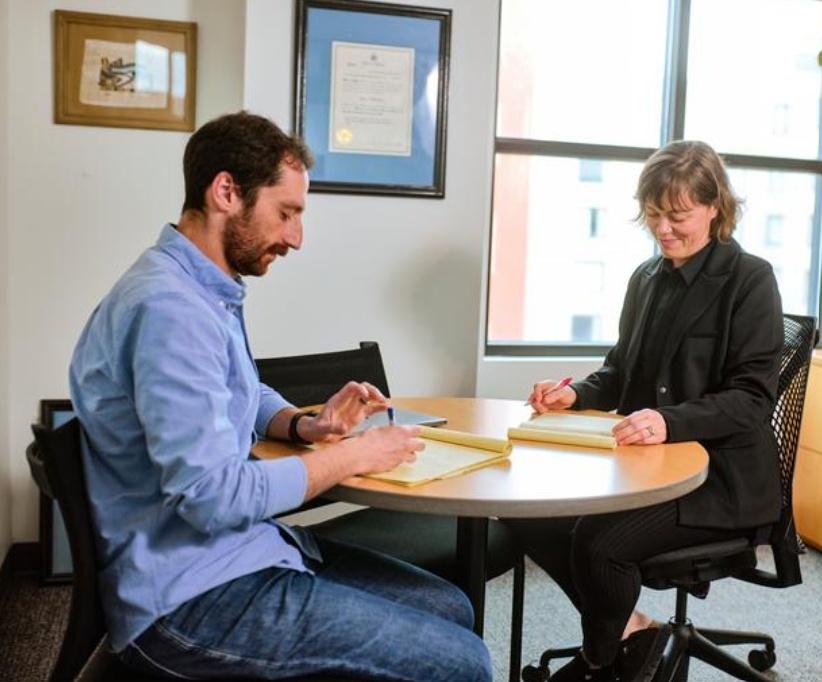
That perspective was shaped well before he arrived at Maine Law. Originally from Maine’s midcoast region, Stern spent nearly a decade working as a community organizer and political strategist for the Sierra Club and a number of other campaigns and organizations. Law school was never part of some carefully constructed long term plan. In fact, for years, it was not part of the plan at all.
Then came 2020.
During the pandemic, Stern and his partner moved from the Boston area back to Maine, settling in Pownal. He found himself at a crossroads, unsure what would come next. Conversations with Maine Law alumni he knew through his organizing work planted the idea that law school might be a natural extension of the work and values that had already guided much of his career.
“I only applied to Maine Law,” Stern said with a laugh. “I got in and got a very nice scholarship. They called my bluff and I had to go.”
What followed was less a rigid career trajectory than an exercise in openness. Stern entered law school intentionally leaving room to explore, though he knew from the beginning that he wanted experiential learning to be central to his education.
That instinct was reinforced during his first summer at a law firm, when a partner offered advice that stayed with him throughout law school.
“You have a little bit of power,” Stern recalled being told, “but what comes with it is a serious responsibility; to that power to help people.”
At Maine Law, Stern intentionally sought experiences that pushed him outside his comfort zone. Some of the most meaningful came through the General Practice Clinic and the Protection from Abuse work at Lewiston District Court, where he represented plaintiffs seeking safety and stability during deeply vulnerable moments in their lives.
The work confirmed what had been drawing him toward public facing advocacy work all along: the chance to directly engage with people during difficult moments and help them navigate systems they could not manage alone.
Law school also unfolded alongside major changes in Stern’s personal life. During his time at Maine Law, he and his partner welcomed a son, who was born during finals week.
Balancing parenthood, clinic work, coursework, and professional opportunities forced Stern to be intentional about how he spent his time. He stepped away from some activities he otherwise might have pursued while remaining involved with organizations like the Environmental and Energy Law Society and volunteer work outside the law school community.
“That’s been really fulfilling because it’s a thing I do out in the world that is not directly tied to law school,” he said.
For Stern, Maine Law’s culture made that balance possible. He said he was drawn to the school’s collegiality and the way students from different backgrounds are encouraged to define success for themselves.
“Maine Law is a school where people come from a lot of different backgrounds and it’s a welcoming place because of that,” Stern said. “To be welcoming you need to have a bit of a choose your own adventure approach.”
After graduation, Stern will join Drummond Woodsum as an associate after interning there last summer. The firm’s work in municipal, conservation, and energy law aligns closely with many of the issues that first drew him into organizing and advocacy work years ago.
Still, his long term goals remain grounded in something simpler.“My big picture intention is to stay in Maine and help communities here by pursuing justice .”