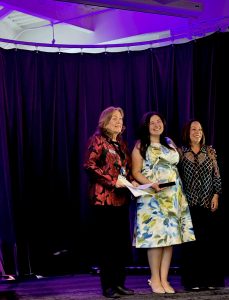
Emily Elmore ’25, did not set out to follow a traditional path after graduating from Maine Law. Instead, she built one, launching her own practice the very day she learned she had passed the bar. But while her trajectory is entrepreneurial, the throughline is something more enduring: a deep commitment to public interest law and a belief that giving back is essential to sustaining it.

Elmore, a veteran Air Force pilot, is the founder of a solo practice of Fieldstone Law & Policy PLLC, which serves York, Franklin, and Androscoggin counties, combining civil and criminal indigent defense with policy and advocacy work. Her firm reflects a deliberate blending of hands-on legal representation and systemic policy work. Her approach is shaped by her experiences as a student attorney, extern, and policy worker while at Maine Law. “My company is really an amalgamation of all those experiences,” she said.
For Elmore, direct representation and broader advocacy are not separate tracks but reinforcing ones. Her work includes defending indigent clients in criminal and civil matters while also engaging in legislative review and policy efforts aimed at addressing the root causes behind the cases she sees every day. “I’m interested not just in addressing acute issues, but also in letting those experiences inform broader advocacy and help people understand what leads to these situations,” she explained.
This dual focus of immediate impact paired with long-term change has also shaped her perspective on community responsibility. In her criminal defense work, she grapples with fundamental questions about fairness and accountability, including who is afforded second chances and why. Those questions, she believes, are not abstract, they are embedded in legal systems and structures that demand thoughtful engagement from lawyers willing to challenge them.
Elmore’s commitment to public interest law is rooted in her time at Maine Law, where she found both inspiration and support. Faculty mentorship played a pivotal role in her development, offering not only guidance but a model of generosity she now seeks to replicate.
“I realized that if I have a successful outcome here, it’s only because others were willing to share their knowledge and wisdom,” she said. “I want to give that back as much as possible.”
That sense of responsibility has translated into tangible action. Elmore recently chose to provide financial support for a Maine Association for Public Interest Law (MAPIL) summer fellowship, motivated by a desire to lower barriers for students interested in similar work. She understands firsthand the financial pressures that can deter graduates from pursuing public interest careers, particularly in fields where salaries are often lower and burnout is a real concern.
“I want to help make it possible for others to pursue this work,” Elmore said. Her contribution reflects a broader philosophy: that sustaining public interest law requires not only passion, but financial and professional support.

Elmore also challenges the notion that public interest work must follow a single model. By building her own firm, she created a structure that allows her to engage in meaningful advocacy while maintaining financial stability and control over her workload. She sees this as one of many viable pathways for lawyers committed to serving their communities, particularly in rural areas where access to legal services remains limited.
Her practice, based in part in small-town Maine, underscores the importance of local engagement. From town meeting governance to remote court access, Elmore has witnessed how legal systems adapt and also where they fall short. She notes that technological shifts, such as increased use of Zoom in rural courts, have improved access for some indigent clients, reducing barriers like transportation and increasing participation in legal proceedings.
Even as her career continues to evolve, Elmore remains focused on the same core principle: that the legal profession carries an obligation to serve. Whether through pro bono work, policy advocacy, or mentorship, she is committed to expanding access to justice and ensuring that others have the opportunity to do the same. Her decision to give back is not separate from her work but a natural extension of it.