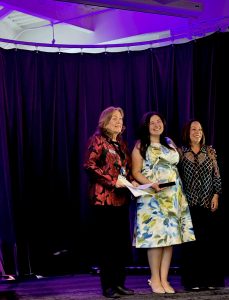
Even before he arrived at Maine Law, Adam Fortier-Brown ’26 had already built a career centered on public service, policy, and advocacy. After several years working in Washington, D.C., on issues ranging from federal legislation to climate resilience and national security, he felt pulled toward something more direct and personal.
“I wanted to do more to help people,” Fortier-Brown said. “And I realized I needed a law degree to do that.”

Fortier-Brown grew up in Randolph, Maine, in a close-knit family alongside his two older brothers and twin sister. His parents own a business selling and repairing boats in Manchester, Maine. Neither of his parents had the opportunity to graduate college, something that shaped how meaningful his educational journey became for his family.
“My parents worked hard so all of my siblings could go to college, and now I’m the first to get an advanced degree,” he said. “The fact that I got to do that all in Maine makes it feel even more special.”
After graduating from the University of Maine in 2019, Fortier-Brown launched into a career that quickly exposed him to the intersection of politics, business, and public policy. As a student, he had already immersed himself in service and leadership opportunities, including founding a chapter of Camp Kesem at the University of Maine and studying abroad in Ireland through the George Mitchell Peace Scholarship program. He later interned for Susan Collins in Washington during one of the most politically charged periods in recent memory, and Secretary William S. Cohen at his global consulting firm.
After graduation, Fortier-Brown returned to Washington, where his work spanned government affairs, energy consulting, and federal policy. He worked as a lobbyist representing recreational boat dealers across the country, helping businesses navigate the challenges of the COVID-19 pandemic and advocating for relief legislation and small business protections. Later, at Deloitte, he worked in risk and energy consulting, helping government agencies improve operations and consider climate and energy resilience. He spent two years as a speechwriter for senior civilian and military leadership of a military department before moving onto a project focused on strengthening security and infrastructure at U.S. facilities overseas.
Despite the breadth of those experiences, Fortier-Brown increasingly found himself drawn back home to Maine and toward the challenges facing rural communities.
“I wrote my whole statement of purpose about wanting to work in a rural community,” he said. “Access to justice in rural Maine was really the issue that drew me to Maine Law initially.”
That commitment to rural communities became one of the defining themes of his time at Maine Law.
As editor-in-chief of the Maine Law Review, Fortier-Brown helped organize a major rural law conference examining issues facing Maine’s largely rural population, including access to justice, infrastructure, aging populations, tribal rights, poverty, and healthcare.
“Maine is one of the few majority-rural states in the country,” he said. “More of our population lives in rural communities than doesn’t.”
Working alongside fellow students and faculty, including collaborations with Nicholas Jacobs at Colby College, the conference became part of a broader effort to strengthen legal pathways and public service opportunities in rural Maine.
“It all happened very organically,” Fortier-Brown said. “It was serendipitous.”
His perspective on the law also evolved dramatically through hands-on legal work during law school. Although he initially expected to pursue criminal prosecution or indigent defense work, his time working with law firm Gideon Asen on litigation related to the Lewiston mass shooting changed his trajectory.
For more than a year, Fortier-Brown worked on legal research and analysis connected to the civil class action litigation brought on behalf of victims and families affected by the tragedy.
“That experience changed my perspective on civil litigation,” he said. “I found it incredibly meaningful.”
The work reinforced for him the practical power of legal advocacy.
“Getting this degree means that when somebody says, ‘Someone should do something about this,’ I can be that someone,” he said. “I can do something about it.”
Following graduation, Fortier-Brown will clerk for Justice Rick Lawrence on the Maine Supreme Judicial Court, an opportunity he says will help him continue building a broad understanding of Maine’s legal system and sharpen the skills he hopes to bring back to communities across the state.
“I have all these different interests and experiences that I think will serve me well,” he said. “There’s still so much to learn about Maine’s legal system and judicial processes, and I think clerking is going to make me a much more capable attorney.”
For Fortier-Brown, the path forward remains rooted in the same place where his journey began: Maine.