On an April afternoon in Portland, far from the ice fields of Greenland and the shifting shipping lanes of the far north, a conversation was taking place about the Arctic that felt far less distant
The 2026 Arctic Law, Science, and Commerce Tenth Anniversary Symposium marked a decade of Maine Law’s leadership in Arctic law and scholarship, bringing together scientists, legal experts, policymakers, and Indigenous leaders to examine one of the most rapidly evolving regions on Earth.
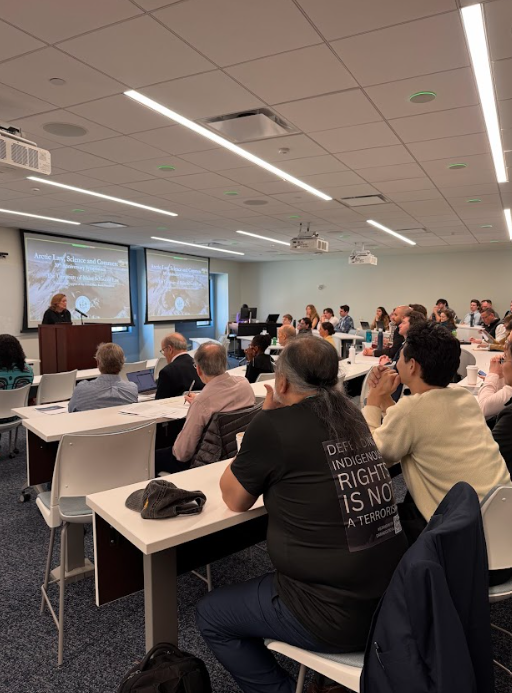
Opening the symposium, Dean and President Leigh Saufley reflected on the institutional commitment that has sustained the program, crediting Professor Charles Norchi with keeping Maine Law “on the cutting edge of a rapidly changing area of law and geopolitics.”
Norchi traced the program’s origins to a convergence of unlikely forces: Arctic science, global shipping, and Maine’s geographic proximity to Europe’s north. What began as a collaboration between legal scholars and climate scientists, sparked, in part, by the arrival of an Icelandic shipping company in Portland, has grown into the only Arctic law program in the United States.
“Our program of teaching and internationally recognized research is robust,” Norchi said, pointing to global partnerships, student exchanges, and fieldwork that extends from Maine to Greenland and beyond. “Our pedagogy is interdisciplinary. Where other law schools sharpen the mind by narrowing it, we believe the mind can be sharpened and broadened simultaneously.”
That philosophy of bridging disciplines rather than isolating them has become the defining feature of Maine Law’s larger mission.
Chancellor Dannel Malloy expanded on that idea, emphasizing the importance of broader public engagement. “We need to have a broader cross section of Americans understand the importance of the work so many of you in this room do,” he said. “We need to be part of a team—and we don’t need to be the captain—but we need to be prepared.”
If the symposium’s opening framed the intellectual foundation, University of Maine Professor Paul Mayewski emphasized urgency. A globally recognized climatologist, Mayewski reflected on how dramatically the conversation around the Arctic has shifted. Once peripheral, the Arctic is now central to global climate understanding, with changes in polar regions shaping weather systems, sea levels, and ecosystems worldwide.
Across the symposium, speakers emphasized that these shifts are not abstract. Panelists highlighted how climate change is already transforming daily life in Arctic communities—affecting housing, food access, and the ability to sustain cultural traditions. They also stressed the critical role of Indigenous knowledge in shaping climate modeling and adaptation strategies, while drawing attention to the real risks faced by Indigenous advocates in geopolitically sensitive regions.
The discussion also turned to the economic and legal implications of a warming Arctic. As ice recedes, new shipping routes and resource opportunities are emerging, raising complex questions about regulation, investment, and international governance. Panelists pointed to persistent uncertainty, with overlapping legal frameworks and competing national interests complicating long-term planning.
That tension carried into broader conversations about governance and geopolitics, where speakers described an Arctic defined by competing perspectives—scientific, economic, Indigenous, and strategic. The region, as Professor Charles Norchi reflected, is not one singular place but “many Arctics,” shaped by shifting priorities and pressures.
Even so, the symposium closed on a note of cautious agency. While the challenges are complex, speakers emphasized that the future of the Arctic will ultimately be shaped by human choices through lenses of science, law, and policy working in concert toward shared interests.
Norchi echoed that complexity in his closing remarks, invoking the idea of “many Arctics,” each shaped by different priorities and pressures. Climate change, shifting global power dynamics, and competing legal frameworks all contribute to a region in flux.
Still, he emphasized that uncertainty does not preclude action. “Preferred futures can be secured by science, law and policy in the common interest,” he said. “Law, after all, is a process of human beings making choices.”
As the symposium concluded the message was clear: the Arctic is no longer remote, either geographically or conceptually. Its future will be shaped by decisions made across disciplines, sectors, and borders.