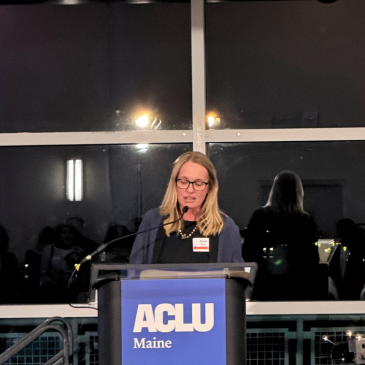
When Professor Jennifer “Jenny” Wriggins first joined the University of Maine School of Law faculty in 1996, she was hired to teach Family Law, supervise students in the Clinics at Maine Law (formerly the Cumberland Legal Aid Clinic), and lead a Women and Law seminar. When a colleague fell ill several years later, she stepped in to teach Torts.
“I loved teaching from the beginning,” she recalled. “It’s very fun for me. When I am working with students I am always learning new things. Curiosity is central to learning, of course, but also to teaching, to scholarship, and to this profession. I was always ready for a new challenge.”
That blend of curiosity, flexibility, and deep commitment to students defined Wriggins’ career. After nearly three decades at Maine Law—filling a variety of roles including Associate Dean for Research, Associate Dean for Academic Affairs, and Interim Co-Director of the Clinics at Maine Law —she will teach her last class in the Fall of 2025 as the Sumner T. Bernstein Professor of Law.
Her colleagues say her impact on Maine Law has been integral to the development of the institution.




“Jenny embodies everything a great law professor should be,” said Interim Provost and Vice Dean Professor Jeffrey Maine, a longtime colleague of Wriggins’. “For over two decades, I’ve seen firsthand her excellence in the classroom, her dedication to rigorous scholarship, and her profound impact on students and faculty alike. She was instrumental in guiding my early career at Maine Law, particularly in impressing upon me the significance of scholarly work, which profoundly influenced my own trajectory. Her presence will be deeply missed by the entire community.”
Before finding her calling in academia, Wriggins practiced law for 12 years in Maine and Massachusetts, working on matters including torts, civil rights, criminal, and family law cases in private practice and the Massachusetts Attorney General Civil Rights Division. She published the widely cited article, Rape, Racism, and the Law while in law school. It was reprinted in numerous books and praised by leading scholars, including former Harvard Law School Dean Martha Minow, who was the first to suggest Wriggins would make an excellent professor. Her extensive scholarship includes many articles and the book, The Measure of Injury: Race, Gender & Tort Law (with M. Chamallas).
It wasn’t just her scholarship that broke ground. Wriggins was open about her sexual orientation from the very start of her legal career, at a time when few others were.
“I’ve been openly gay since college,” she said. “It hasn’t been an issue for me at Maine Law, thankfully. And fortunately the University of Maine started a domestic partnership program in 1996 when I began here so that I was able to have my partner – now my spouse but at that time we could not get married – on my health insurance. This was an important and fair innovation that sent a very positive message when I was thinking about joining the faculty.”
Her openness and authenticity—combined with her influential scholarship in many areas of law —helped shape not only her students’ learning, but also the culture of Maine Law itself.
“One of the most positive developments at Maine Law has been the massive expansion of curricular options. And for me, one of the most satisfying aspects has been the Information Privacy program,” she says. She started the Information Privacy Certificate in 2016 as Associate Dean under the leadership of former Dean Danielle Conway, together with Maine Law grads Trevor Hughes ‘95 and Justin Weiss ‘06. Now under Professor Scott Bloomberg’s leadership, she said it has been thrilling to watch the program blossom.
Guiding Generations of Lawyers in Maine and Beyond
Over the years, Wriggins taught in the clinic and also taught Torts, Civil Procedure, Family Law, Insurance Law, Health Law, and upper-level seminars exploring race, gender, and sexual orientation in the law. She relished the chance to bring new perspectives into the first-year curriculum, especially by integrating equality concerns such as race and racism into discussions of core doctrinal areas like Torts.
“It’s been so exciting to see the many things our grads have done in the private and public sectors.” She cites graduates like Robyn Merrill ’05, whose idea for a statewide referendum led to Maine’s historic Medicaid expansion, Heather Sanborn ’07, who moved from business leadership to become Maine’s Public Advocate, and Clint Boothby ‘99, who built a successful rural private practice from scratch and combined it with varied and important community engagement, including serving on the Board of Directors of MaineHealth.
“One of the things that’s great about Maine Law is the connection to public service in the state,” Wriggins said. “It’s been rewarding to see graduates do meaningful things—from the courts, to government, to working in community health centers, and more. Equally important is the work lawyers do in private practice – it’s essential for clients who need our profession’s services, and for democracy as well. The staff and faculty have been terrific to work with and that has been a real joy throughout my time here. The times it rained in my office in the old building haven’t lessened my enthusiasm for Maine law,” she laughed.
Wriggins has also served as a constant source of mentorship and support for her colleagues, especially junior professors like Associate Professor Kaitlin Caruso who began her teaching career in 2021.
“From my very first moments at Maine Law, I have had the great fortune of teaching Civil Procedure alongside Jenny,” said Caruso. “Especially in those early classes, her presence was a comfort and her deep expertise an incredible gift. Jenny is a lead-by-example demonstration of what the best of law school teaching can be, and I have benefitted from that as much as our students have!”


For Wriggins, the enjoyment of teaching was inseparable from the responsibility of preparing lawyers in the face of what she feels is a fractured and fragile democracy.
“We are in an incredibly threatening time for democracy,” she said. “The legal profession’s role is really important right now, and training people to enter that profession has been an honor.”
Looking Ahead
Wriggins’ legacy at Maine Law and the Maine legal community is indelible, Maine Law President and Dean Leigh Saufley said.
“Jenny Wriggins has been a pillar of Maine Law for nearly three decades,” Saufley added. “ Her brilliance as a scholar, her generosity as a mentor, and her courage in living authentically and with great integrity have left an indelible mark on this community. She has shaped generations of lawyers who carry forward her commitment to justice and public service, and her legacy will inspire our students and faculty for years to come.”
As she looks toward retirement, Wriggins does not see relaxing in her plans. She will remain in Maine with her spouse, enjoying gardening, reading, and traveling, but she is also eager to continue her engagement with issues of justice, ethics, and faith—all values that have been shaped and honed by her time at Maine Law.
“The values of this school are really consonant with mine, that commitment toward public service in lots of different ways,” she said. “Training the next generations of lawyers, fighting for ethics, transparency in government, and the rule of law—it has all been a privilege.”